Data, Data, Data
I am a data player,
and currently I am mainly playing with the data related to supernovae.
I will play something else and find something new, I promise.
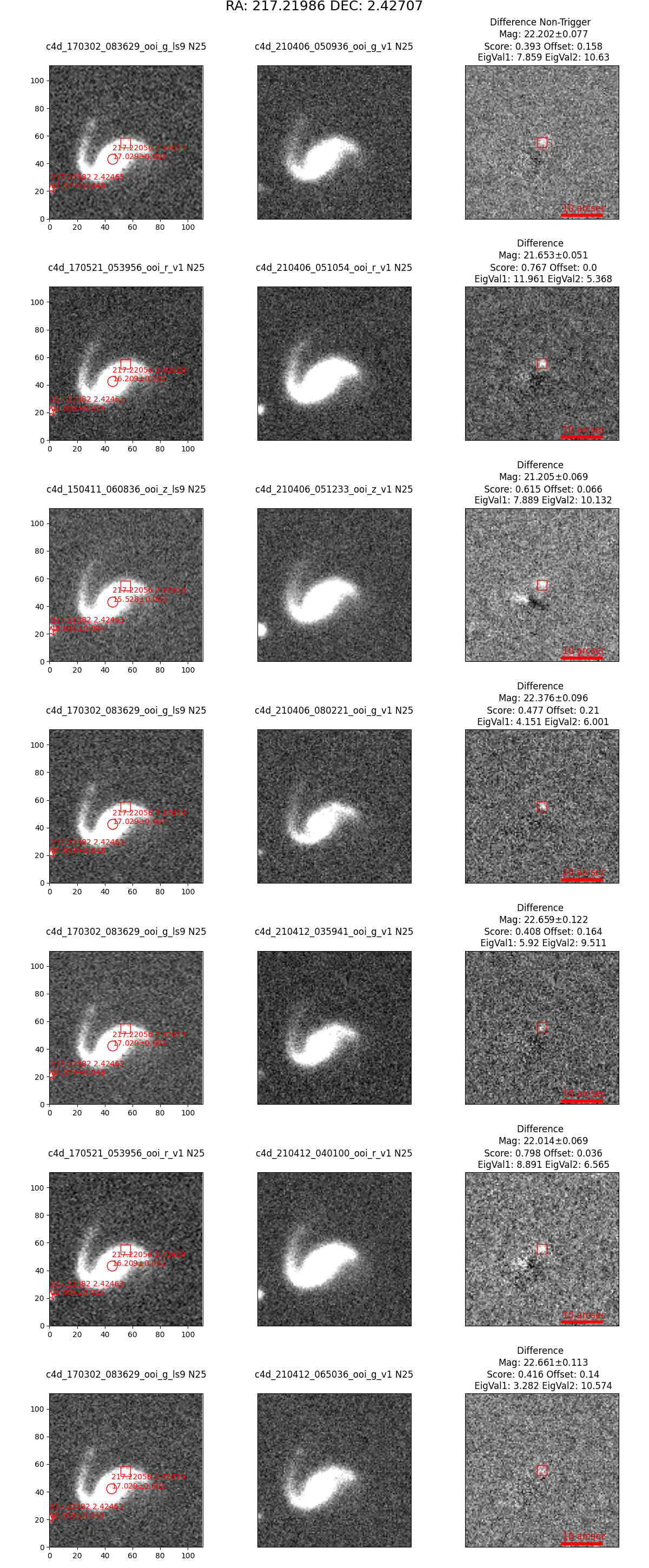
My third research project is using the Blanco 4m telescope to find supernova candidates. Finding supernova candidates uses a technology called "image subtraction": the new image minus the old image of the same sky area, anything left in the residual can be either supernova candidates or mistakes. We use a novel algorithm based on spatial varying fast fourier transformation to do the image subtraction and minimize the mistakes, and we use GPU to accelerate the calculation. The image above is an example of a supernova candidate we found. The left column shows the old images from DECam Legacy Survey, the middle column shows the new images we took at Apr 6th and Apr 9th, the right column shows the difference between the old and the new images. As of Apr 14 2021, we have found 451 supernovae and active galactic nuclei candidates.
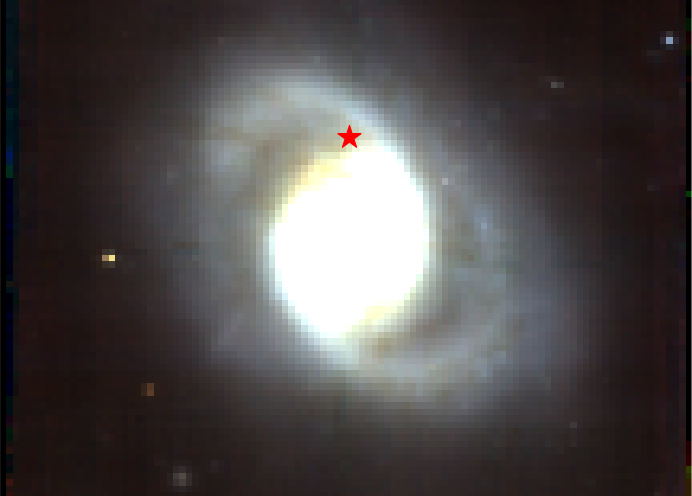
My second research project is studying the supernova host galaxy properties using several integral field unit (IFU) spectrograph facilities (i.e. MUSE, MaNGA, Califa). In the previous-generation spectrometer, there is only one spectra for an astronomical source, no matter the target is a star or a galaxy or a nebula. However, in IFU, the spectra of a galaxy at different coordinates can be observed simultaneously. This feature allow us to study the stars, gases and dust at different regions of a galaxy and make comparison. We are focusing on the pixel where a supernova was once exploded, to see if the supernova-related region is special relative to the galaxy. A supernova host galaxy is shown in the picture above, the supernova coordinate is marked as red star, data from ESO Data Archive.
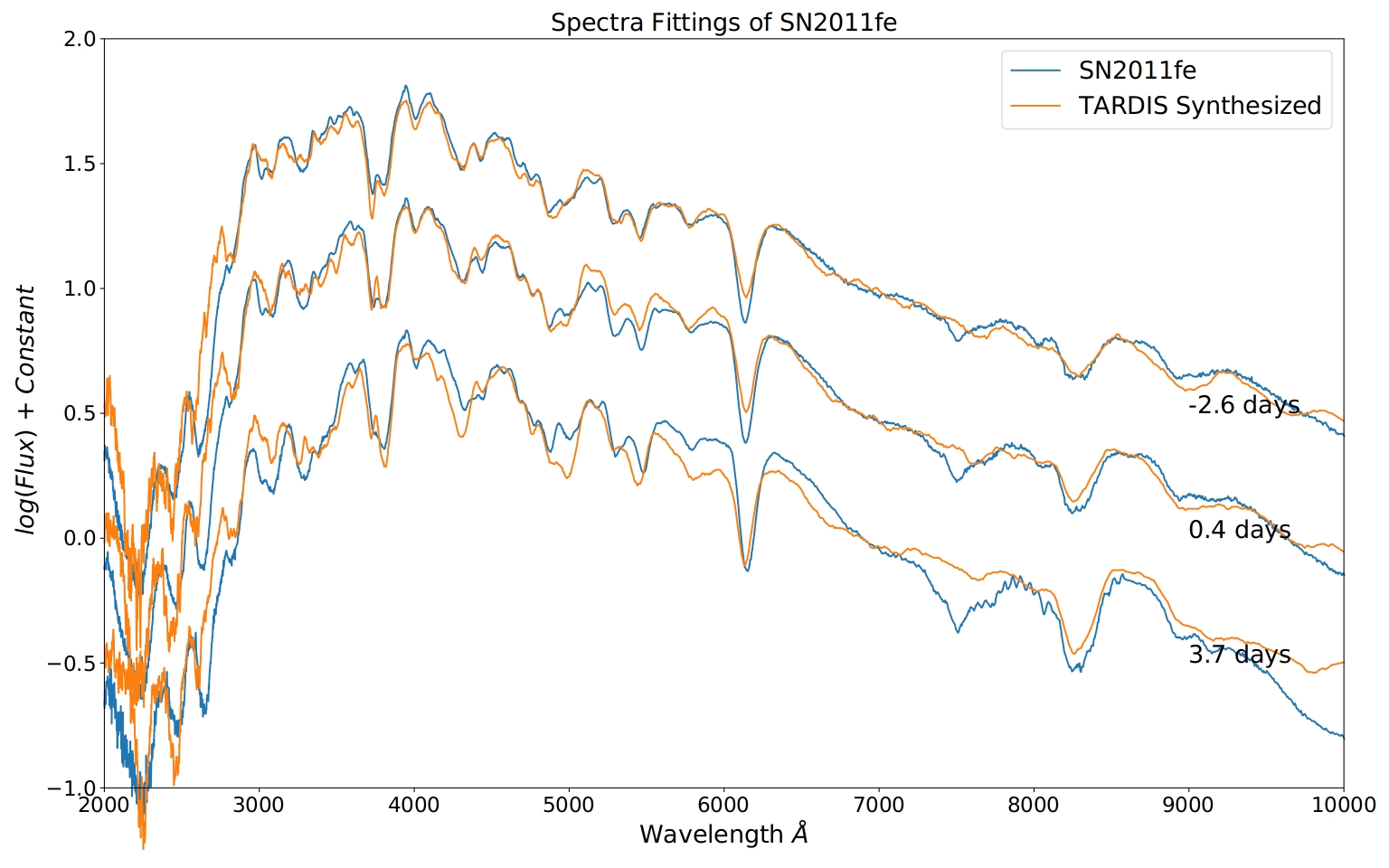
My first research project is radiative transfer simulations of type Ia supernovae. Simulating a supernova explosion is a complicated task, which involves nucleosynthesis (calculate nuclear reaction rates that produce various elements from white dwarf progenitor's elements), hydrodynamics (calculate how the explosion wave propogates), and even neutrino physics (this is important for core collapse supernovae), et cetera. Our calculation on radiation transfer is after all these process, when different elements mix in the ejecta and illuminated by a central gamma ray source, to study how will the photon travel through the plasma and form the spectra as we have observed.
Spectra contains important information about the element abundances of ejecta structure, and matching spectral features to atomic lines is quite easy. For example, in type Ia supernovae, the big dip at 6300 Angstrom comes from silicon II ion; the "w" shape feature around 5500 Angstrom comes from sulphur II ion. However, it is quite hard to link the line strenth to the element mass, especially for Fe, Co, Ni and other elements with multiple lines mixed together. In the current study, we use convolutional neural network to estimate the element abundances from spectra and we found after we train the neural network on the simulated spectra, we can predict the element abundances from the real observed spectra. In our first attempt, we used a simple radiation transfer code called "TARDIS" and a multiple residual convolutional neural network to analyze the type Ia supernovae spectra around their maximum luminosity, details are in Here.
.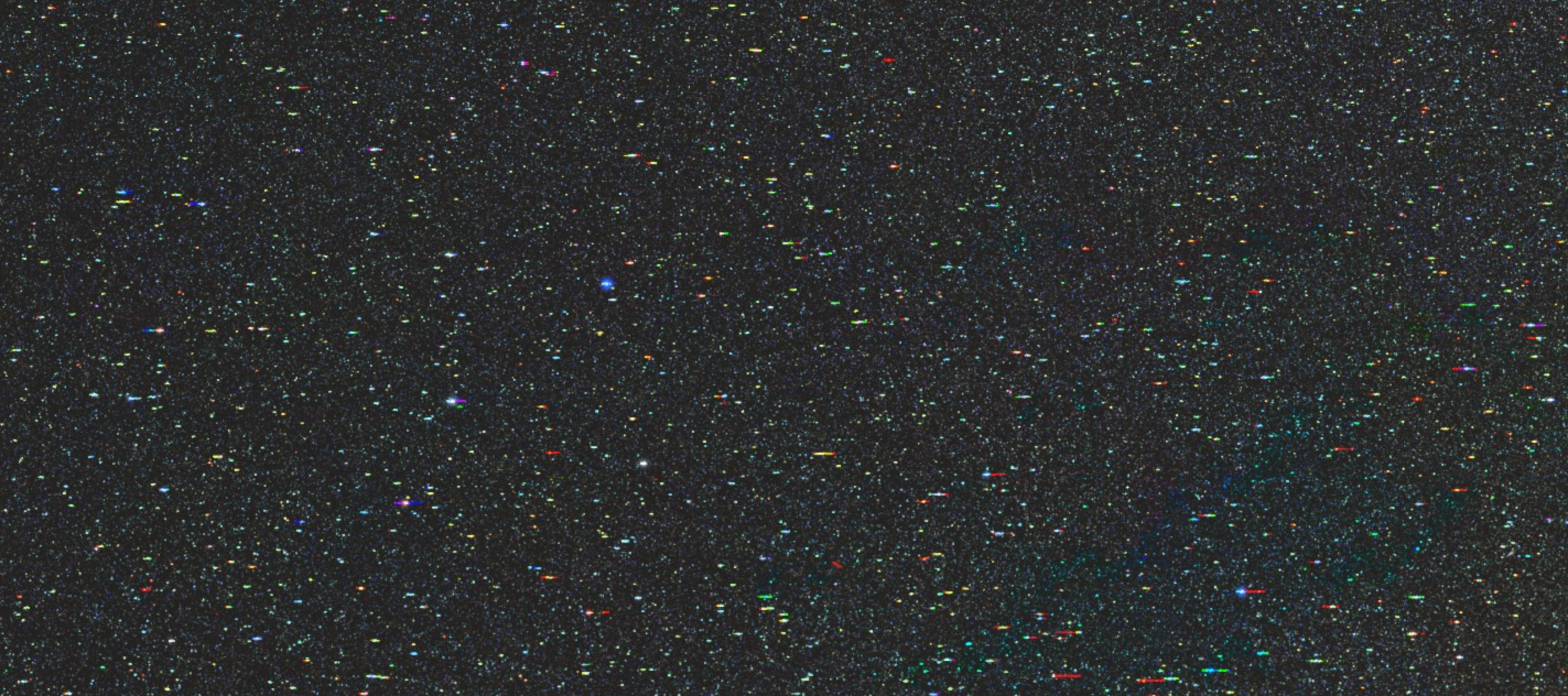
My zeroth research project is playing data in astronomy. We have so many telescopes that do the observation every night (or even every day for some radio telescopes), while we don't have many professors, students or any other kinds of researchers. For example, the image comes from DECam Legacy Survey and took months of observation time, but not many researches fully utilized all the galaxies or stars, and no one knows how many supernovae remain undiscovered in these images. Sadly, many observations are made while leave the data undigested. Not to mehtion, few researchers can really appreciate the art of data analysis, although they are excellent in physics, mathematics or instrumentation. As a consequence, we may still unaware of the physics that we have observed thousands of times may. I am here, to unveil the physics behind the data.